Tag: EPA

The First Global Plastics Treaty at Risk

By: Nicholas Rodriguez

The First Global Plastics Treaty at Risk

Is the first-ever international treaty addressing plastic pollution at risk? In March of 2022, the United Nations (UN) announced its plan to create the first international, legally binding agreement to end plastic pollution.[1] The original agreement was expected to be finalized by the end of 2024.[2] Now entering 2026 with the stalling of negotiations[3] and the departure of the treaty chair[4], the first-ever global plastics treaty seems to be at risk.

The Plastic Pollution Problem

The harms of plastic pollution are primarily attributable to both the production and disposal of plastic products. Production begins with fossil fuels, as over 90% of plastic is produced using crude oil and natural gas extracted through processes such as drilling and fracking.[5] The raw materials are then refined into plastic pellets to later be molded into plastic products.[6] In 2019, the production process alone accounted for 3.4% of global greenhouse gas emissions.[7] Moreover, global plastic production is estimated to have doubled from 2000 to 2019.[8]

Additionally, plastic disposal poses further environmental harm. The U.S. Environmental Protection Agency (EPA) found that plastic products can take between “100 to 1,000 years or more” to fully decompose, depending on environmental factors.[9] Furthermore, the EPA estimated that in 2018, 8% of U.S. plastic waste was recycled while 76% was landfilled.[10] Plastic waste in landfills results in microplastics that are carried to the surrounding environment by air and leachate.[11] Microplastics in the environment cause potential health risks in both wildlife and humans.[12]

UN Plastics Treaty Sessions

In March of 2022, at a UN environmental assembly in Nairobi, the end plastic pollution resolution was adopted.[13] The resolution directed the Intergovernmental Negotiating Committee (INC) to develop a legally binding treaty on plastic pollution by the end of 2024.[14] The treaty was to address the protection of the marine environment, national reporting requirements, alternative product design of plastics, sound waste management methods, and potential compliance issues with the treaty.[15]

Since the adopted resolution, the INC has hosted six sessions, inviting countries and organizations to participate in and negotiate treaty provisions.[16] The process of INC sessions has generally followed common legislative procedures. Members submit proposals to the Secretariat, which is then circulated and debated between members.[17] After the debate, the proposal may be subject to a vote that requires more than a 50% affirmative vote to pass and be included in the agreement.[18] The sessions may also utilize small committees to resolve niche issues.[19] The process prioritizes consensus over efficiency, which results in the session reopening issues that were thought to have already been resolved.

The last session, INC-5.2, was hosted on August 5, 2025, in Geneva, Switzerland, and consisted of 1,400 delegates from 183 countries and around 1,000 observers representing over 400 organizations.[20]

Coalition Agreement Concerns

Throughout the INC sessions, there have been growing concerns about the inability of country delegates to reach a consensus on the scope and authority of the treaty.

Criticism has surrounded the two most prominent country coalitions, The High Ambition Coalition (HAC) and the Global Coalition for Plastics Sustainability (GCPS), for their fundamental disagreement on many issues in the treaty.

Upon the UN adoption of the plastics treaty proposal, the countries of Rwanda and Norway created the HAC.[21] HAC’s main priority is creating an immediately functional treaty that will end plastic pollution by 2040.[22] The HAC has pushed for the treaty to focus on strong provisions governing plastic design, production, consumption, and the entire life cycle of plastic products.[23] Specifically, HAC has called for provisions in the treaty to include binding reporting requirements for all nations, standardized global targets to lower plastic production, and mechanisms to assess implementation.[24] HAC currently consists of 75 countries[25]

Conversely, during the third INC session, the countries of Iran, Russia, China, Cuba, Saudi Arabia, and Bahrain announced the formation of the Global Coalition for Plastics Sustainability (GCPS).[26] The GCPS has emphasized goals of governing plastic waste management strategies and refraining from mandatory disclosures and reporting.[27] Specifically, the GCPS has been against provisions limiting plastic production.[28]

In the latest INC session, the two coalitions created a deadlock over whether the treaty should include provisions to reduce plastic production and have global, legally binding controls on chemicals used to make plastics.[29] Many countries were disappointed by the lack of progress of the INC-5.2, with a representative of Madagascar explaining that “the world is expecting action, not reports from us.” [30] The final draft of the agreement contained nearly 1,500 brackets placed around text, signifying it had not yet been resolved.[31] INC-5.2 marked the third session after the expected completion date, which ended without a treaty.

Lobbying Concerns

Additionally, there have been further concerns about the lobbying attempts of certain organizations. The strong presence of lobbyists at INC-5.2, including the fossil fuel and chemical industry, has drawn criticism from various session members. [32] Specifically, nineteen fossil fuel and chemical lobbyists have joined the national delegations of Egypt, Kazakhstan, China, Iran, Chile, and the Dominican Republic. [33] Overall, the number of fossil fuel and chemical industry lobbyists outnumbered the delegations of all European Union nation delegates combined.[34] Their presence throughout the sessions has made members call for a conflict-of-interest policy, which has yet to be adopted.[35]

Future of the Treaty

On October 7, 2025, two months after INC-5.2, the chair of the UN plastics treaty talks, Luis Vayas Valdivieso, announced he would be resigning from the position.[36] Following the resignation, the UN announced that it will be holding an emergency one-day session on February 7, 2026, in Geneva, Switzerland, with the sole focus on the election of officers, including a new chair.[37]

[1] UN Environment Programme Res. 14, UNEP/EA.5 (March 7, 2022).

[2] Id.

[3] Emma Farge & Olivia Le Poidevin, Plastic pollution treaty stalled as Geneva talks end without deal, Reuters (August 15, 2025, at 12:29 CDT), https://www.reuters.com/sustainability/climate-energy/plastic-pollution-treaty-stalled-geneva-talks-end-without-deal-2025-08-15/ [https://perma.cc/9626-Q3JR].

[4] Emma Bryce et al., UN plastics treaty chair to step down with process in turmoil, The Guardian (October 7, 2025, at 08:07 EDT), https://www.theguardian.com/environment/2025/oct/07/un-plastics-treaty-chair-to-step-down-with-process-in-turmoil [https://perma.cc/3MSN-H8FF].

[5] Cho, Clare Y et al., Cong. Rsch. Serv., R48293, Plastic Pollution and Policy Considerations: Frequently Asked Questions 2 (2025).

[6] Id. at 4.

[7] Plastic Leakage and greenhouse gas emissions are increasing, Orginsation for Economic Co-operation and Development (August 18, 2022), https://www.oecd.org/en/data/insights/data-explainers/2022/08/plastic-leakage-and-greenhouse-gas-emissions-are-increasing.html [https://perma.cc/249M-5K6C].

[8] Cho, supra note 5, at pg 6.

[9] Impacts of Plastic Pollution, EPA, https://www.epa.gov/plastics/impacts-plastic-pollution [https://perma.cc/B6JN-QTD2] (last visited November 13, 2025).

[10] Cho, supra note 5, at pg 8.

[11] Irena Wojnowska-Baryla et al., Plastic Waste Degradation in Landfill Conditions: The Problem with Microplastics, and Their Direct and Indirect Environmental Effects, International Journal of Environmental Reasearch and Public Health, Oct. 14, 2022, at 12.

[12] Renee Sharp & Avinash Kar, What You Need to Know About the Plastic Crisis, NRDC (April 9, 2024), https://www.nrdc.org/bio/avinash-kar/what-you-need-know-about-plastic-crisis [https://perma.cc/6P2Y-V6CR].

[13]UN Environment Programme, supra note 1.

[14] Id.

[15] Id.

[16] Talks on global plastic pollution treaty adjourn without consensus, UN Environment Programme (August 15, 2025), https://www.unep.org/news-and-stories/press-release/talks-global-plastic-pollution-treaty-adjourn-without-consensus [https://perma.cc/SN5P-J5NN].

[17] Draft rules of procedure for the work of the intergovernmental negotiating committee to develop an international legally binding instrument on plastic pollution, including in the marine environment, UNEP/PP/INC.4/2 (January 25, 2024).

[18] Id.

[19] Id.

[20] Talks on global plastic pollution treay adjourn without consens, supra note 16.

[21] Press Release: Countries aim to end plastic pollution by 2040, High Ambition Coalition To End Plastic Pollution (August 22, 2022), https://hactoendplasticpollution.org/press-release-countries-aim-to-end-plastic-pollution-by-2040/ [https://perma.cc/VA7A-HWSZ].

[22] Id.

[23] Id.

[24] HAC Member States Ministerial Joint Statement for INC-5, High Ambition Coalition To End Plastic Pollution (September 25, 2024), https://hactoendplasticpollution.org/hac-member-states-ministerial-joint-statement-for-inc-5/ [https://perma.cc/C69C-YXWB].

[25] High Ambition Coalition To End Plastic Pollution, https://hactoendplasticpollution.org [https://perma.cc/WB7Z-M9U2] (last visited November 13, 2025).

[26] Tosca Ballerini, Global Plastics Treaty, Iran Surprisingly Announces New Coalition, Renewable Matter (November 14, 2023, at 12:00), https://www.renewablematter.eu/en/global-plastics-treaty-iran-surprisingly-announces-new-coalition [https://perma.cc/VY43-DQW7].

[27]Joseph Winters, UN Plastics Treaty Talks Once Again End in Failure, Wired (August 16, 2025) https://www.wired.com/story/un-plastics-treaty-talks-once-again-end-in-failure/ [https://perma.cc/F2DM-QM3J].

[28] Id.

[29] Jennifer McDermott, No end in sight to plastic pollution crisis as treaty negotiations in Geneva fail, AP News (August 15, 2025, at 13:51 CST), https://apnews.com/article/plastic-pollution-treaty-negotiations-united-nations-geneva-e73090282a22be7ff5979ea2d648dc10 [https://perma.cc/5456-6P2H].

[30] Id.

[31] Hiroko Tabuchi, Plastic Pollution Talks Collapse as Oil States Oppose Tough Treaty, New York Times (August 15, 2025), https://www.nytimes.com/2025/08/15/climate/plastic-pollution-treaty-talks-collapse.html [https://perma.cc/3UGD-LNPC].

[32] Fossil Fuel and Petrochemical Lobbyists Overrun Plastics Treaty Negotiations, Center for International Environmental Law (August 7, 2025), https://www.ciel.org/news/inc-5-2-lobbyist-analysis/ [https://perma.cc/C28T-BS3R].

[33] Id.

[34] Id.

[35] Damian Carrington, “Total infiltration”: How plastics industry swamped vital global treaty talks, The Guardian (July 23, 2025, 05:37 EDT), https://www.theguardian.com/environment/2025/jul/23/total-infiltration-how-plastics-industry-swamped-vital-global-treaty-talks [https://perma.cc/9VMY-TNNZ].

[36] Emma Bryce et al., supra note 4.

[37] Third Part of the Fifth Session (INC-5.3), UN Environment Programme, https://www.unep.org/inc-plastic-pollution/session-5.3 [https://perma.cc/APT9-9QFL] (last visited November 13, 2025).

Silent Emissions: The Trump EPA’s Attack on Greenhouse Gas Reporting

By: Annmarie Buckley

Silent Emissions: The Trump EPA’s Attack on Greenhouse Gas Reporting

On September 12, 2025, the Trump Environmental Protection Agency (EPA) announced a proposed rule to end the Greenhouse Gas Reporting Program (GHGRP).[1] The GHGRP requires reporting greenhouse gas emissions and other relevant emissions data, such as fuel and industrial gas suppliers and CO2 injection sites.[2]

Read More

Trump and the Border Wall Construction: The Persistent Fight Against the Environmental Laws Waiver

By: Diana Salinas-Murillo

The Arizona Border Wall Extension Project

Recently, environmentalists have raised a rare constitutional challenge against the Secretary of Homeland Security’s authority in waiving over 30 environmental statutes for the expedited construction of the US-Mexico border wall.

Read More

The PFAS Crisis: The Future of “Forever Chemical” Regulation

The PFAS Crisis: The Future of “Forever Chemical” Regulation

By: Annmarie Buckley

Over the previous presidential term, the Biden administration made significant strides in promoting environmental regulations against “forever chemicals” in drinking water. The administration prioritized increased regulations of these man-made chemicals, scientifically defined as PFAS (perfluoroalkyl or polyfluoroalkyl substances), in response to mounting public concern regarding their detrimental impacts on environmental and human health.

Read More

EPA Finalizes New WOTUS Rule

EPA Finalizes New WOTUS Rule

By: Joseph Garza


Federal agencies take actions to clarify conflicting legal standards set by the Supreme Court that have divided Circuit Courts for decades. The ongoing legal question regarding the definition of a “Water of the United States” (“WOTUS”) in the context of Clean Water Act (“CWA”) enforcement and implementation may seemingly have been answered. On January 18, 2023, the Environmental Protection Agency (“EPA”) and the Army Corps of Engineers (the “Corps”) announced the finalization of the “Revised Definition of the WOTUS” rule (the “New Rule”).[i] EPA’s hope in promulgating the New Rule is to solve confusion caused by Rapanos v. U.S. The definition of a WOTUS is crucial to CWA practice because it determines the scope of the CWA’s reach. Only a WOTUS will receive the CWA’s protections. It is crucial for all who work with the CWA to have a clear understanding of the definition of WOTUS.

Read More

Consent Decree Requires EPA to Comply with Clean Air Act Obligations

A California federal court recently approved an agreement between the United States Environmental Protection Agency (“EPA”) and the Center for Biological Diversity (the “Center”) that requires EPA to take affirmative steps to ensure that eight states have plans in place to reduce emissions from their oil and gas extraction areas as mandated by the Clean Air Act (“CAA” or “Act”).[i]

Emphasizing health hazards like asthma and reduced lung function that can develop in people who endure prolonged exposure to ground-level ozone (i.e., smog), the Center noted that the agreement will likely improve the health of residents who live closest to the extraction areas.[ii] The Center estimates that as many as 70 million people live in these areas and are at the greatest risk of exposure to harmful asthma-causing smog from oil and gas extraction operations.[iii]

Read More

[NEWS 11/24/2019] U.S. EPA awards $3.6 million in Grants to Restoration Programs on Lake Erie

On November 19, 2019, the U.S. Environmental Protection Agency (“EPA”) awarded five grants totaling nearly $3.6 million to organizations dedicated to clean-up and restoration activities across Lake Erie.[1] The grants were awarded to the Ohio EPA, Ohio Lake Erie Commission (“OLEC”), Ohio Department of Natural Resources, and the Northeast Ohio Four County Regional Planning and Development Organization, and are part of a broader mission by the EPA to restore and protect the Great Lakes region.[2]

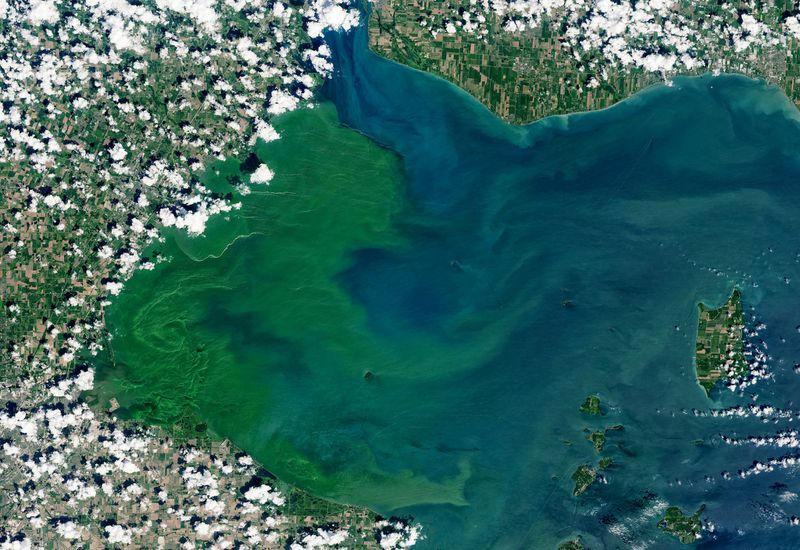
The grants follow a July 2019 algae bloom outbreak that was among the most severe and toxic since scientists began tracking algae blooms in the early 2000’s.[3] The bloom covered nearly 620 square miles over the surface of Lake Erie, an area more than twice the size of Chicago.[4] Greater rainfall in recent years has increased erosion and flooding along Lake Erie’s coast line, which allows farm fertilizers and waste water to infiltrate the lake while higher temperatures cause the blooms to expand further and last longer.[5]

Certain programs that received funding through the EPA’s grants will tackle the threat of algae blooms head on. These programs include a plan by the Ohio EPA and OLEC to reduce phosphorus runoff and to protect and restore streams and wetlands by working with farmers as well as a grant to develop and implement the Lakewide Action Management Plans for Lake Erie and Remedial Action Plans for Lake Erie areas of concern.[6]

*Featured Image: The 2019 toxic algae bloom that formed in western Lake Erie. In a NASA satellite image taken on July 30, 2019, the green medley of plankton and bacteria had grown larger than New York City. (USGS/NASA Landsat).

[1] Press Release: EPA announces grants to advance clean-ups in Ohio’s Lake Erie Watershed and Areas of Concern, USEPA (Nov. 19, 2019) https://www.epa.gov/newsreleases/epa-announces-grants-advance-clean-ups-ohios-lake-erie-watershed-and-areas-concern (last visited Nov. 22, 2019).

[2] Id.

[3] Tony Briscoe, The shallowest Great Lake provides drinking water for more people than any other. Algae blooms are making it toxic — and it’s getting worse, Chicago Tribune (Nov. 14, 2019) https://www.chicagotribune.com/news/environment/great-lakes/ct-lake-erie-climate-change-algae-blooms-20191114-bjkteorf5vg2hfu3cgqxe2ncru-story.html (last visited Nov. 22, 2019).

[4] Id.

[5] Algae Bloom in Lake Erie Poses Major Health Threat, NOAA (Aug. 15, 2019) https://www.nesdis.noaa.gov/content/algae-bloom-lake-erie-poses-major-health-threat (last visited Nov. 22, 2019).

[6] Laura Johnston, U.S. EPA announces $3.6 million in Lake Erie grants, Cleveland.com (Nov. 19, 2019) https://www.cleveland.com/news/2019/11/us-epa-announces-3-million-in-lake-erie-grants.html (last visited Nov. 22, 2019).

[BLOG, Sept. 19, 2019] ENVIRONMENTAL DEREGULATORY LANDSCAPE IN 2019 By Jonathan Swisher

Environmental Deregulatory Landscape in 2019

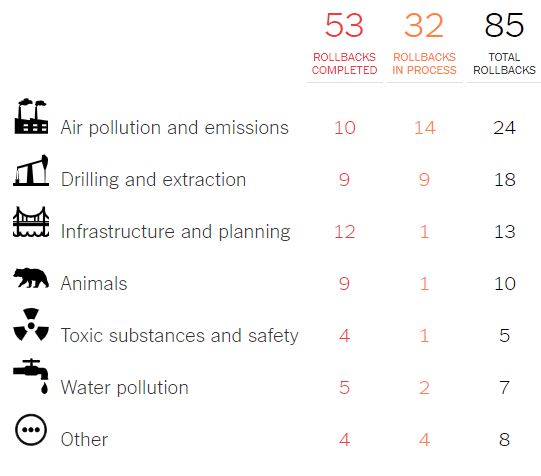
President Trump believes that “an ever-growing maze of regulations, rules, restrictions [sic] has cost our country trillions and trillions of dollars, millions of jobs, countless American factories, and devastated many industries.”[1] He campaigned on the promise to eliminate the Environmental Protection Agency (“EPA”) “in almost every form,” leaving “only tidbits” intact.[2] According to the White House, “President Trump has reduced a historic number of burdensome and unnecessary regulations and stopped the massive growth of new regulations.”[3] The Administration’s environmental deregulatory agenda includes 85 rollbacks in air pollution and emissions standards, drilling and extracting, infrastructure and planning, wildlife protection, toxic substances and safety, and water pollution.[4] In the EPA’s FY 2020 Budget in Brief, the stated mission of the EPA is to “protect human health and the environment,” and according to the EPA, “we can all agree that we want a clean, healthy environment that supports a thriving economy.”[5] The report went on to say, “[e]nvironmental stewardship that supports a growing economy is essential to the American way of life and key to economic success and competitiveness.”[6]

The Administration’s most recent deregulatory success came with abandoning the Obama-era definition of what qualifies as “waters of the United States,” which provided enhanced protections for wetlands and smaller waterways. Under the new Rule, only wetlands “that are adjacent to a major body of water, or ones that are connected to a major waterway by surface water” will be federally protected.[7] The EPA gave four reasons for repealing the 2015 Clean Water Rule: (1) the Rule exceeded the agencies implementing authority based on Justice Kennedy’s significant nexus test in Rapanos;[8] (2) the Rule failed to adequately consider that it is the responsibility and right of the States to protect and “plan the development and use . . . of land and water resources’”; (3) to avoid future unconstitutional land encroachments by the federal government; and (4) the “distance-based limitations” suffer from “procedural errors” and lack “adequate record support.”[9] At a press hearing for the repeal, EPA Administrator, Andrew Wheeler, said that the EPA is “delivering on the president’s regulatory reform agenda,” and the agency is working on 45 more deregulatory actions.[10]

Critics of the Administration’s deregulatory agenda in the EPA have come just short of classifying it as “regulatory capture.”[11] Regulatory capture occurs when agency regulation departs from the public interest, and is directed towards the regulated industry. Although falling short of regulatory capture, critics believe the Administration’s actions show “an ambitious, intensifying movement to cripple the EPA’s capacity to confront polluting industries and promote public and environmental health.”[12] They further contend that the consequences of this deregulatory agenda “will likely fall hardest on vulnerable social groups, such as low-income communities, farmworkers, and first responders.”[13] On the other hand, proponents of the Administrations regulatory reform agenda are celebrating how the “Environmental Protection Agency managed to exceed its deregulatory goal” of removing two rules for every one they proposed.[14]

In addition to deregulation, the EPA has proposed to eliminate 41 current EPA programs and sub-programs while drastically cutting its budget in 2020. The EPA’s FY 2020 Budget in Brief requested $6.068 billion, which “represents a $2.76 billion, or 31 percent reduction from the Agency’s FY 2019 Annualized Continuing Resolution.”[15] The EPA contends that this budget is sufficient to support its “highest priorities” and fulfill its “critical mission for the American people.”[16] Among the programs to be cut are: Environmental Education, Pollution Prevention, Reducing Lead in Drinking Water, Regional Science and Technology and Water Quality Research and Support Grants.[17] While it is unlikely that the proposed budget cuts will be approved by Congress, the FY2020 Budget in Brief signifies a continued departure from the Obama-era expansion of the EPA.

With 85 environmental regulatory rollbacks, a proposed 31 percent reduction in funds, and the elimination of “funding for fourteen voluntary climate-related partnership programs,” President Trump is delivering on his campaign promise to eliminate the EPA “in almost every form.”[18] While the Administration continues to deliver on its promise, according to a 2019 Gallup Poll, “[b]y the widest margin since 2000, more Americans believe environmental protection should take precedence over economic growth when the two goals conflict.”[19] Currently, sixty-five percent of Americans, Republican and Democrat, believe that the environment should take priority over “a thriving economy.”[20]

While President Trump has not managed to eliminate the EPA “in every form,” he has managed to erode many of the environmental law principles which guided the agency for many years. Many States are pushing back against the Administration’s deregulatory agenda and countless lawsuits challenging their actions have been filed.

*Featured Image: 84 Environmental Rules Being Rolled Back Under Trump, The New York Times (Sept. 12, 2019).

[1] President Donald J. Trump’s Historic Deregulatory Actions are Benefiting American Families, Workers, and Businesses The White House, https://www.whitehouse.gov/briefings-statements/president-donald-j-trumps-historic-deregulatory-actions-are-benefiting-american-families-workers-and-businesses/ (last visited Sep 15, 2019).

[2] The Fox News GOP debate transcript, annotated The Washington Post, https://www.washingtonpost.com/news/the-fix/wp/2016/03/03/the-fox-news-gop-debate-transcript-annotated/ (last visited Sep 15, 2019).

[3] The Office of White House, supra, n. 1.

[4] Nadja Popovich, Livia Albeck-Ripka, and Kendra Pierre-Louis, 84 Environmental Rules Being Rolled Back Under Trump, The New York Times (Sept. 12, 2019), https://www.nytimes.com/interactive/2019/climate/trump-environment-rollbacks.html (last visited Sep 15, 2019) (A New York Times analysis, based on research from Harvard Law School and Columbia Law School).

[5] FY 2020 EPA Budget in Brief, p. 1 (March 2019), https://www.epa.gov/sites/production/files/2019-03/documents/fy-2020-epa-bib.pdf.

[6] Id.

[7] Bill Chappell, EPA Makes Rollback Of Clean Water Rules Official, Repealing 2015 Protections, NPR, https://www.npr.org/2019/09/12/760203456/epa-makes-rollback-of-clean-water-rules-official-repealing-2015-protections (last visited Sep 15, 2019).

[8] Rapanos v. United States, 547 U.S. 715, 126 S.Ct. 2208, 165 L.Ed.2d 159 (2006).

[9] Definition of “Waters of the United States” – Recodification of Pre-Existing Rules (Pre-Publication Version) EPA (Sept. 12, 2019), https://www.epa.gov/wotus-rule/definition-waters-united-states-recodification-pre-existing-rules-pre-publication-version (last visited Sep 15, 2019) (quoting 33 U.S.C. 1251(b)).

[10] Id.

[11] Lindsey Dillon et al., the “EPA Under Siege” Writing Group, The Environmental Protection Agency in the Early Trump Administration: Prelude to Regulatory Capture, NCBI, S90 (2018), https://www.ncbi.nlm.nih.gov/pmc/articles/PMC5922212/pdf/AJPH.2018.304360.pdf.

[12] Id.

[13] Id.

[14]EPA exceeds 2-for-1 deregulation goal set by Trump administration, Federal News Network, (Sept. 3, 2019), https://federalnewsnetwork.com/federal-drive/2019/09/epa-exceeds-2-for-1-deregulation-goal-set-by-trump-administration/ (last visited Sept. 23, 2019).

[15] FY 2020, supra, n. 5 at 1-2.

[16] Id. at 2.

[17] Id. at 89-93.

[18] Id. at 94.

[19] Lydia Saad, Preference for Environment Over Economy Largest Since 2000, Gallup (April 4, 2019) https://news.gallup.com/poll/248243/preference-environment-economy-largest-2000.aspx (“Results for this Gallup poll are based on telephone interviews conducted March 1-10, 2019, with a random sample of 1,039 adults, aged 18 and older, living in all 50 U.S. states and the District of Columbia. For results based on the total sample of national adults, the margin of sampling error is ±4 percentage points at the 95% confidence level”) (last visited September 18, 2019).

[20] See FY2020, supra, n. 5.

Powered by WordPress & Theme by Anders Norén